Getting Started

Create AI Agents based on intelligence, not job titles

In Sordit, Agents are defined by the AI models that power them, not by fixed roles or personalities. Create as many Agents as you need, choose the right level of intelligence for each Task, and let Sordit provide the instructions.

Creating your Agents

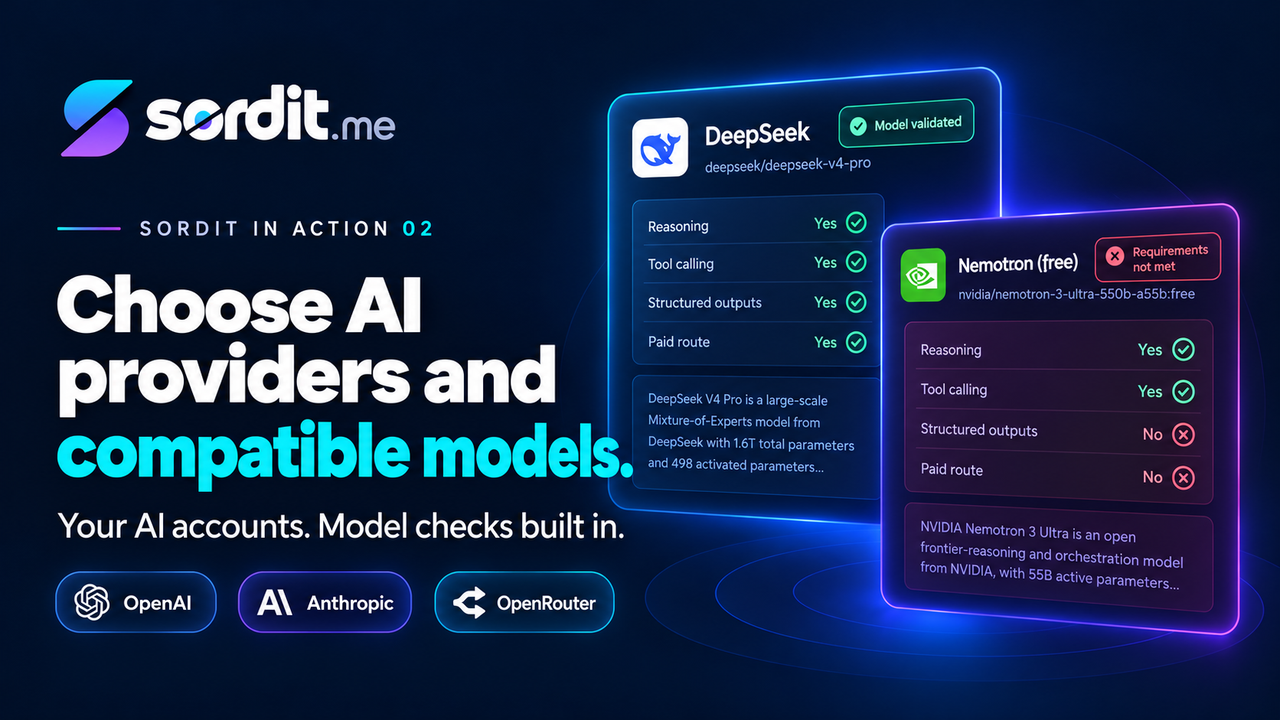
Once you’ve activated your AI providers, you can start creating Agents in Sordit.

When creating an Agent, you choose:

  • AI provider: OpenAI, Anthropic or OpenRouter.
  • AI model: The model that will power your Agent.
  • Reasoning level: How much reasoning effort the model should apply.

Under the hood, Sordit uses OpenAI Codex to run Agents powered by OpenAI and OpenRouter models, while Anthropic models run through the Claude Agent SDK.

You can create unlimited Agents, and each Agent can work on multiple Tasks in parallel.

Agents are differentiated by intelligence, not identity

Many AI platforms encourage you to create Agents with specific roles, such as a Sales Agent, Research Agent or Finance Agent, each with its own personality and instructions.

Sordit takes a different approach.

Agents are distinguished by their underlying AI model and reasoning capabilities.

For example:

  • GPT-6 Luna: A practical choice for everyday Tasks such as reviewing emails, organising information or preparing straightforward summaries.
  • Claude Opus 5.5: An option for more demanding Tasks involving complex reasoning, modelling or detailed analysis.
  • OpenRouter models: Additional choices across different levels of capability, speed and cost.

These Agents aren’t restricted to particular business functions. The same Agent can perform research, review documents or prepare reports depending on the Task it receives.

Agent OClaude Opus 5.5Deeper reasoning
Analyse a proposalModel scenariosReview a contractAssess risksResearch a marketDevelop a strategy
Agent LGPT-6 LunaEveryday operations
Review emailsPrepare a follow-upSummarise a briefOrganise filesDraft an updatePrepare meeting notes
Agent DDeepSeek V4 ProBalanced
Research a prospectReview documentsCompare suppliersSummarise findingsPrepare a reportCheck an invoice

The Job provides the instructions

As people and AI increasingly work together, the way organisations structure and assign work is evolving. Rather than relying entirely on fixed roles and job descriptions, work can be organised around outcomes, with the right people and AI capabilities brought in as needed.

Sordit is designed around this approach.

Jobs define what needs to be achieved, while Tasks provide the specific instructions and context. Agents supply the intelligence needed to carry out those Tasks.

This means an Agent doesn’t need a permanent identity, personality or separate instruction file. The same Agent can contribute to different business functions, depending on the work assigned to it.

Choosing the right intelligence for the work

A more powerful model isn’t necessary for every Task, and a cheaper model isn’t always the most economical choice.

A lightweight model might complete a simple Task efficiently but struggle with a complex workflow, leading to additional attempts, longer execution times or incomplete work.

When assigning Agents, consider the complexity of the Task, the reliability you need and the overall cost of completing it.

For a practical example, read Why the Cheapest AI Model Wasn’t the Cheapest Worker.

Create your first Agent in Sordit →
← Back to In Action